Harry Potter and the Philosopher’s Stone: a complete Book Guide
Harry Potter and the Philosopher’s Stone (released in the United States as Harry Potter and the Sorcerer’s Stone) is far more than a children’s fantasy novel. It represents the birth of a cultural phenomenon that has shaped an entire generation’s relationship with reading, storytelling, and imagination. Published on June 26, 1997, by Bloomsbury in the United Kingdom, this debut novel by J.K. Rowling introduced readers to an eleven-year-old orphan who discovers he is a wizard and is invited to attend Hogwarts School of Witchcraft and Wizardry.
What began as a modest print run of 500 copies has since become the foundation of a multimedia empire, with the Harry Potter series selling over 600 million copies worldwide and spawning eight blockbuster films, theme parks, stage plays, and countless merchandise items [1].
The book’s success was not immediate, nor was it guaranteed. Rowling’s manuscript was rejected by twelve publishers before Bloomsbury took a chance on it. Yet within a few years, Harry Potter had become a household name, and the series had revitalized the children’s book market, proving that young readers were hungry for complex, imaginative stories.
This article provides an in-depth exploration of Harry Potter and the Philosopher’s Stone, examining its plot, characters, themes, literary significance, and lasting cultural impact.
Publication details
|
Aspect
|
Detail
|
|
Original Title
|
Harry Potter and the Philosopher’s Stone
|
|
US Title
|
Harry Potter and the Sorcerer’s Stone
|
|
Author
|
J.K. Rowling
|
|
Genre
|
Fantasy, Young Adult, Children’s Literature
|
|
Publisher (UK)
|
Bloomsbury Publishing
|
|
Publisher (US)
|
Scholastic Corporation
|
|
UK Publication Date
|
26 June 1997
|
|
US Publication Date
|
1 September 1998
|
|
Illustrator (UK First)
|
Thomas Taylor
|
|
Illustrator (US First)
|
Mary GrandPré
|
|
Pages (UK First)
|
223
|
|
Pages (US First)
|
309
|
|
ISBN (UK First)
|
978-0-7475-3269-9
|
|
Initial Print Run
|
500 copies (300 to libraries)
|
|
Total Sales
|
Over 120 million copies
|
|
Languages
|
Translated into over 80 languages
|
The first edition of Harry Potter and the Philosopher’s Stone is now one of the most valuable modern books. In December 2021, a first edition hardback sold at auction for £356,000 (approximately $470,000), setting a record for a Harry Potter book [2]. The rarity and value of these first editions stem from the tiny initial print run and the fact that many copies were sent to libraries, where they were read, damaged, or lost over time.
Dedication: in honor of three important women
The book opens with a heartfelt dedication:
“For Jessica, who loves stories, for Anne, who loved them too, and for Di, who heard this one first.”
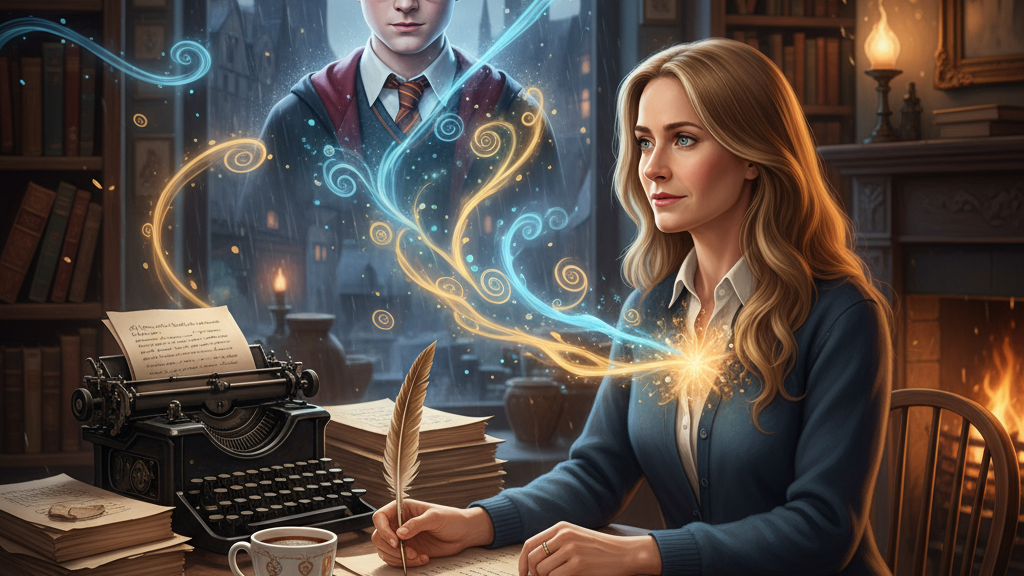
This dedication honors three important women in J.K. Rowling’s life. Jessica is Rowling’s eldest daughter, born in 1993 while Rowling was writing the book. Anne is Rowling’s mother, who died of multiple sclerosis in December 1990, just six months after Rowling conceived the idea for Harry Potter. Rowling has said that her mother’s death profoundly influenced the themes of love and loss in the series. Di is Rowling’s younger sister, Dianne, who was one of the first people to hear the story and provided encouragement during the writing process [3].
The story behind the story: how Harry Potter came to be
The genesis of Harry Potter is almost as magical as the story itself. On a delayed train journey from Manchester to London in 1990, J.K. Rowling conceived the idea of a young boy who discovers he is a wizard. She has described how the character of Harry Potter simply “walked into” her mind, fully formed, during that four-hour train delay. By the time she arrived in London, she had outlined much of the first book in her head [4].
Over the next five years, Rowling meticulously planned the entire seven-book series, creating detailed backstories for characters, mapping out plot arcs, and building the intricate magical world. She wrote much of the first book in cafés around Edinburgh, Scotland, often with her infant daughter Jessica asleep in a stroller beside her. During this period, Rowling faced significant personal challenges. She was a single mother living on state benefits, struggling with depression, and dealing with the recent death of her mother. She later described this time as being “as poor as it is possible to be in modern Britain without being homeless” [4].
The manuscript for Harry Potter and the Philosopher’s Stone was completed in 1995. Rowling’s agent, Christopher Little, submitted it to twelve publishing houses, all of which rejected it. Some publishers felt it was too long for a children’s book; others thought it wouldn’t appeal to the target audience. Finally, in 1996, Barry Cunningham, an editor at Bloomsbury, agreed to publish the book. The decision was reportedly influenced by his eight-year-old daughter, Alice, who read the first chapter and immediately demanded to read the rest [5]. Cunningham advised Rowling to get a day job, telling her she would never make money writing children’s books. How wrong he was.
Plot summary Harry Potter and the Philosopher’s Stone: the journey begins
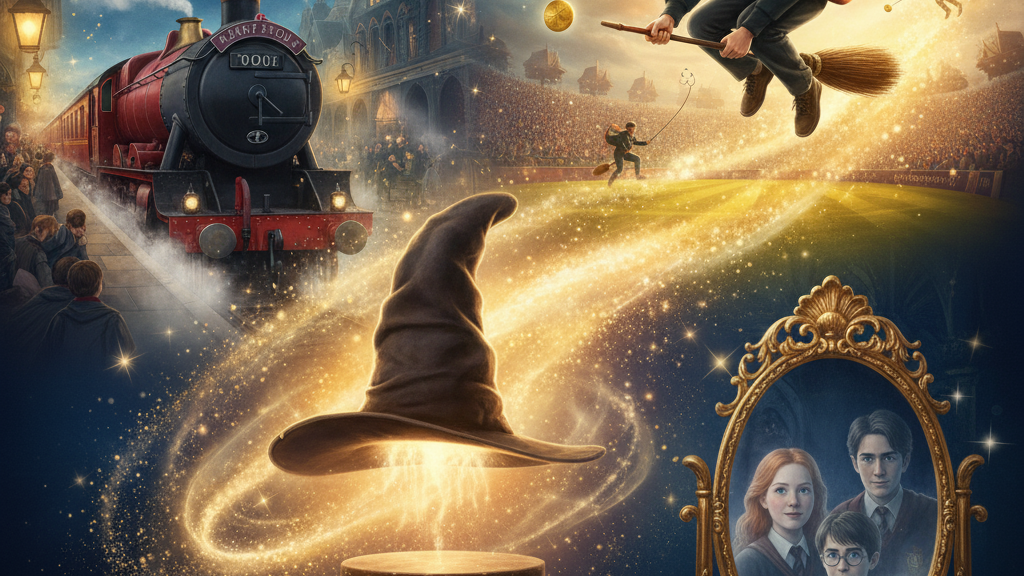
Harry Potter and the Philosopher’s Stone follows the classic hero’s journey structure, taking Harry from his mundane, oppressive life with the Dursleys to the magical world of Hogwarts, where he discovers his true identity and faces his first confrontation with the dark forces that killed his parents.
Chapter 1: The boy who lived
The novel opens on a seemingly ordinary Tuesday in November 1981, focusing on the Dursley family of Number Four, Privet Drive, Little Whinging, Surrey. Vernon Dursley, the director of a drill-making firm called Grunnings, prides himself on being “perfectly normal.” His wife, Petunia, is equally conventional, spending her days caring for their spoiled infant son, Dudley, and spying on the neighbors. However, this particular day is anything but normal. Vernon notices strange occurrences: people in cloaks celebrating in the streets, owls flying in broad daylight, and a tabby cat reading a map outside his house. He overhears people talking about “the Potters” and their son Harry, which disturbs him because the Potters are his wife’s estranged sister and brother-in-law [6].
That evening, after the Dursleys have gone to bed, the cat transforms into Professor Minerva McGonagall, Deputy Headmistress of Hogwarts School of Witchcraft and Wizardry. She is waiting for Albus Dumbledore, the headmaster of Hogwarts and one of the most powerful wizards in the world. Dumbledore arrives and uses a device called a Deluminator to extinguish all the streetlights on Privet Drive. McGonagall and Dumbledore discuss the momentous events of the previous night: Lord Voldemort, the most feared dark wizard in a century, attacked the Potter family in Godric’s Hollow. He murdered James and Lily Potter but mysteriously failed to kill their fifteen-month-old son, Harry. Instead, Voldemort’s killing curse rebounded, seemingly destroying him and leaving Harry with only a lightning-shaped scar on his forehead [6].
Rubeus Hagrid, the Keeper of Keys and Grounds at Hogwarts, arrives on a flying motorcycle, carrying baby Harry. The three wizards are somber as they discuss leaving Harry with his only remaining relatives, the Dursleys, who despise magic. Dumbledore insists it is for the best, as Harry will be protected by an ancient magic tied to his mother’s sacrifice. He leaves Harry on the doorstep with a letter explaining the situation. As Dumbledore departs, he says, “Good luck, Harry Potter,” and the chapter ends with the infant sleeping peacefully, unaware that he is already famous throughout the wizarding world as “The Boy Who Lived” [6].
Chapters 2-4: A decade of neglect and the arrival of Hogwarts letters
Nearly ten years pass. Harry Potter, now almost eleven, lives a miserable existence with the Dursleys. He sleeps in a cramped cupboard under the stairs, wears Dudley’s oversized hand-me-down clothes, and is treated as a servant. The Dursleys have told him his parents died in a car crash and have forbidden him from asking questions about them. Strange things often happen around Harry—his hair grows back overnight after a bad haircut, he once found himself on the school roof when fleeing Dudley’s gang, and a sweater Aunt Petunia tried to force on him mysteriously shrank—but he has no explanation for these occurrences [6].
On Dudley’s eleventh birthday, the Dursleys take him to the zoo, and Harry is forced to come along. At the reptile house, Harry has a conversation with a boa constrictor. When Dudley shoves Harry aside to get a better look, Harry becomes angry, and the glass of the enclosure vanishes, allowing the snake to escape. The Dursleys punish Harry severely, locking him in his cupboard for an extended period [6].
Shortly before Harry’s eleventh birthday, a letter arrives for him, addressed to “Mr. H. Potter, The Cupboard Under the Stairs, 4 Privet Drive, Little Whinging, Surrey.” Uncle Vernon snatches it away before Harry can read it. More letters arrive, each more specifically addressed than the last, including one that reads “The Smallest Bedroom” after the Dursleys move Harry out of the cupboard to stop the letters. Vernon becomes increasingly frantic, boarding up the mail slot and eventually fleeing with the family to a dilapidated hut on a rock in the sea [6].
At the stroke of midnight on Harry’s eleventh birthday, there is a tremendous pounding on the door. Hagrid bursts in, furious that the Dursleys have kept Harry in the dark about his heritage. He gives Harry a slightly squashed birthday cake and reveals the truth: Harry is a wizard, and he has been accepted to Hogwarts School of Witchcraft and Wizardry. Hagrid also tells Harry the real story of his parents’ deaths and explains that Voldemort, the dark wizard who killed them, failed to kill Harry, leaving him with his famous scar. The Dursleys’ attempts to suppress Harry’s magic have failed [6].
Chapters 5-6: Discovering the Wizarding World
Hagrid takes Harry to Diagon Alley, a hidden magical shopping street in London, accessed through the back of a pub called the Leaky Cauldron. Harry is astonished by the magical world and overwhelmed by his fame. Everywhere he goes, witches and wizards recognize him and want to shake his hand. At Gringotts Wizarding Bank, run by goblins, Harry discovers that his parents left him a small fortune in a vault. Hagrid also retrieves a mysterious package from another vault on Dumbledore’s orders [6].
Harry buys his school supplies, including a wand from Ollivanders. The wandmaker, Mr. Ollivander, tells Harry that his wand contains a phoenix feather from the same phoenix that provided the feather for Voldemort’s wand. Ollivander remarks ominously that Harry is destined for great things, as Voldemort did “great things—terrible, yes, but great” [6]. As a birthday present, Hagrid buys Harry a beautiful snowy owl, whom Harry names Hedwig.
A month later, Harry boards the Hogwarts Express from Platform Nine and Three-Quarters at King’s Cross Station. On the train, he meets Ron Weasley, a red-haired boy from a large wizarding family, and they quickly become friends. They also encounter Hermione Granger, a bossy but brilliant girl from a non-magical (Muggle) family, and Draco Malfoy, an arrogant boy who insults Ron and tries to befriend Harry. Harry instinctively dislikes Draco and refuses his offer of friendship [6].
Chapters 7-11: Life at Hogwarts
Upon arriving at Hogwarts, the first-year students are sorted into one of four houses: Gryffindor, Hufflepuff, Ravenclaw, or Slytherin. The Sorting Hat, a sentient magical hat, considers putting Harry in Slytherin, the house known for producing dark wizards, but Harry silently begs not to be placed there. The Hat respects his choice and places him in Gryffindor, along with Ron and Hermione [6].
Harry quickly adapts to life at Hogwarts. He excels in Defence Against the Dark Arts and flying lessons but struggles with Potions, taught by the stern and seemingly malevolent Professor Severus Snape, who appears to have a personal vendetta against Harry. During his first flying lesson, Harry displays a natural talent for broomstick flying, which earns him a place on the Gryffindor Quidditch team as Seeker, the youngest player in a century [6].
One night, Harry, Ron, Hermione, and Draco are caught out of bed and chased by the school caretaker, Argus Filch. They hide in a forbidden corridor on the third floor and encounter a monstrous three-headed dog guarding a trapdoor. Hermione notices the dog is standing on a trapdoor and deduces that it is guarding something [6].
On Halloweeen, a mountain troll is let into the dungeons. Harry and Ron rescue Hermione from the troll in the girls’ bathroom, and the three become close friends. During Harry’s first Quidditch match, his broomstick is jinxed, causing it to buck and spin wildly. Hermione sees Snape muttering what appears to be a curse and sets his robes on fire, breaking his concentration and saving Harry. The trio becomes convinced that Snape is trying to steal whatever the three-headed dog is guarding [6].
Chapters 12-17: The mystery of the Philosopher’s Stone and the final confrontation
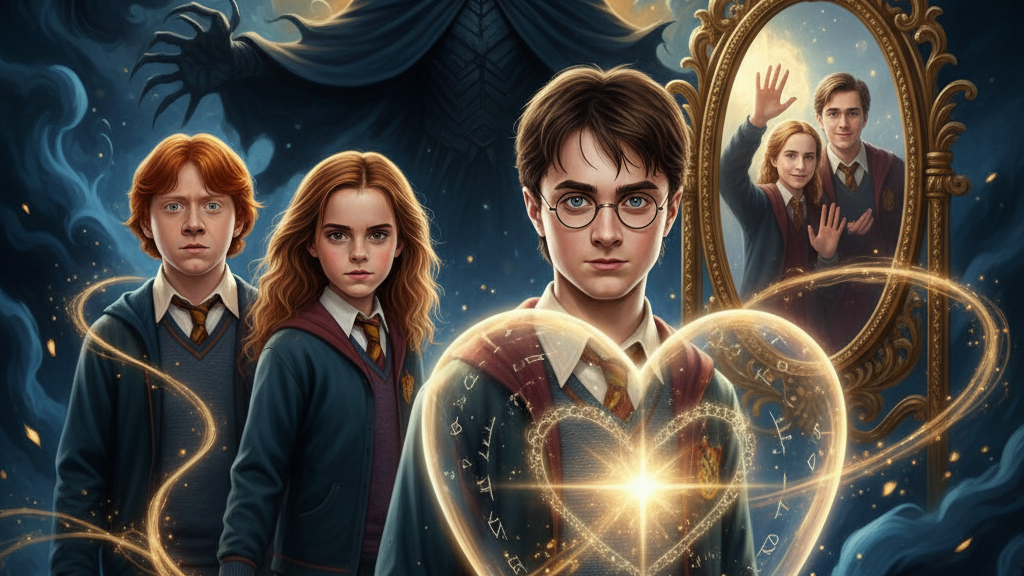
On Christmas Day, Harry receives an anonymous gift: his father’s Invisibility Cloak, one of the most rare and valuable magical objects. Using the cloak, Harry explores the castle at night and discovers the Mirror of Erised in an abandoned classroom. The mirror shows the viewer their deepest desire; Harry sees himself surrounded by his family. Dumbledore finds Harry and explains that the mirror shows what we most desire, not reality, and that dwelling on it can be dangerous. He tells Harry the mirror will be moved [6].
Harry, Ron, and Hermione learn that the three-headed dog, whom Hagrid has named Fluffy, is guarding the Philosopher’s Stone, a legendary alchemical object created by Nicolas Flamel. The Stone can transform any metal into gold and produce the Elixir of Life, granting immortality. The trio becomes convinced that Snape is trying to steal the Stone for Voldemort [6].
When they learn that Dumbledore has been lured away from Hogwarts by a fake message from the Ministry of Magic, they fear the theft is imminent. Despite their fear, Harry, Ron, and Hermione decide to go through the trapdoor to protect the Stone. They bypass Fluffy by playing music to lull him to sleep, then face a series of magical challenges designed by the Hogwarts teachers. Ron sacrifices himself in a life-sized game of Wizard’s Chess, and Hermione solves a logic puzzle involving potions, but only Harry proceeds to the final chamber [6].
In the final chamber, Harry finds not Snape, but Professor Quirrell, the nervous Defence Against the Dark Arts teacher. Quirrell reveals that he has been serving Voldemort all along. It was Quirrell who let the troll into the school and jinxed Harry’s broom; Snape was actually trying to save Harry by counter-cursing the broom. Quirrell explains that Voldemort has been possessing him, living on the back of his head, hidden by a turban. When Quirrell unwraps his turban, Harry sees Voldemort’s face, snake-like and terrifying, protruding from the back of Quirrell’s skull [6].
Quirrell tries to use the Mirror of Erised to locate the Stone, but the mirror only reveals it to someone who wants to find it but not use it. When Harry looks in the mirror, he feels the Stone drop into his pocket. Voldemort orders Quirrell to seize the Stone from Harry, but when Quirrell touches Harry’s skin, his hands blister and burn. Harry realizes that Quirrell cannot touch him without suffering terrible pain. In the struggle, Harry’s scar burns with excruciating pain, and he passes out [6].
Harry awakens three days later in the hospital wing. Dumbledore explains that Harry survived because of the protection his mother left him when she died trying to save him. Lily Potter’s love created a powerful magical charm that lives in Harry’s skin, and it is this love that burned Quirrell, who was full of hatred, greed, and ambition. Dumbledore also reveals that Voldemort abandoned Quirrell to die and fled, still weak and without a body, but not destroyed. The Philosopher’s Stone has been destroyed to prevent it from falling into the wrong hands. Nicolas Flamel and his wife, Perenelle, who are over 600 years old, have enough Elixir stored to set their affairs in order before they die [6].
At the end-of-year feast, Gryffindor wins the House Cup, thanks to last-minute points awarded to Harry, Ron, Hermione, and Neville Longbottom for their bravery. Harry returns to the Dursleys for the summer, but he is no longer the same boy. He knows who he is, he has friends, and he has a place where he belongs.
Main characters
Harry Potter
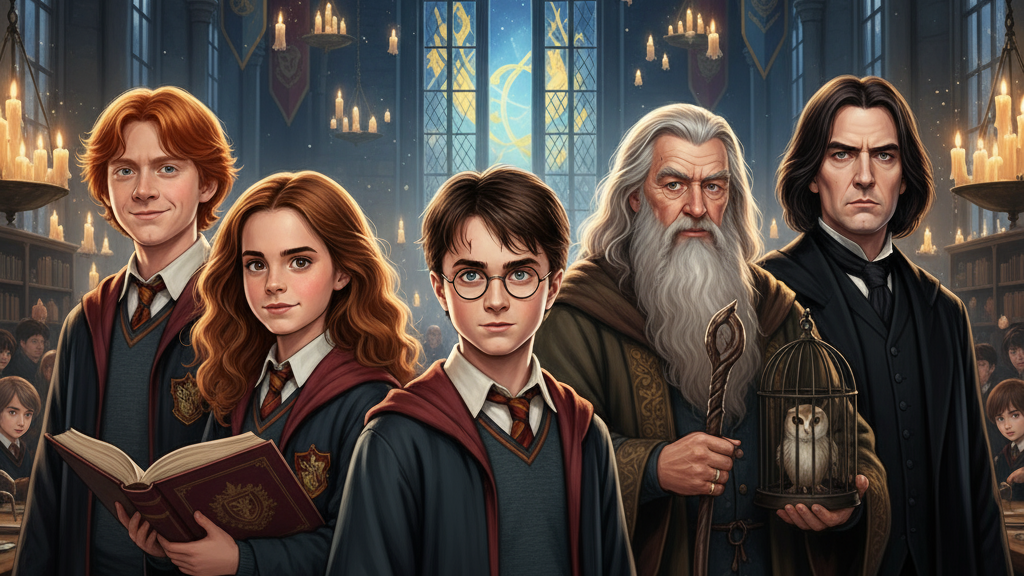
Harry James Potter is the protagonist of the series and the titular character of the book. At the start of the story, Harry is a scrawny, undernourished eleven-year-old with messy black hair, bright green eyes, and round glasses held together with tape. His most distinctive feature is the lightning-bolt-shaped scar on his forehead, a remnant of Voldemort’s failed killing curse. Harry is humble, brave, and fiercely loyal. Despite his fame in the wizarding world, he remains modest and uncomfortable with attention. His experiences with the Dursleys have made him empathetic to others who are mistreated or marginalized. Harry has a strong moral compass and an instinctive sense of right and wrong. He is also impulsive and sometimes reckless, traits that lead him into danger but also demonstrate his courage [7].
Ron Weasley
Ronald Bilius Weasley is Harry’s first friend in the wizarding world and becomes his best friend. Ron is tall, gangly, and red-haired, with freckles covering his face. He comes from a large, loving, but financially struggling pure-blood wizarding family. Ron is the sixth of seven children, and he often feels overshadowed by his older brothers’ achievements and his younger sister’s uniqueness. Despite his insecurities, Ron is fiercely loyal, brave, and has a good sense of humor. He provides Harry with a connection to wizarding culture and traditions. Ron’s strategic thinking is showcased during the Wizard’s Chess game, where he sacrifices himself to allow Harry to proceed [7].
Hermione Granger
Hermione Jean Granger is the brightest witch of her age and the third member of the central trio. She has bushy brown hair, brown eyes, and prominent front teeth (which she later has magically reduced). Hermione is Muggle-born, meaning both her parents are non-magical. She is highly intelligent, studious, and logical, often relying on books and knowledge to solve problems. At the beginning of the book, Hermione is somewhat insufferable, constantly showing off her knowledge and correcting others. However, after Harry and Ron save her from the troll, she becomes more humble and loyal. Hermione’s quick thinking and extensive knowledge save the trio multiple times throughout the book. She represents the value of hard work and intelligence [7].
Albus Dumbledore
Albus Percival Wulfric Brian Dumbledore is the headmaster of Hogwarts and one of the most powerful and respected wizards in the world. He is described as tall and thin, with long silver hair and a beard, half-moon spectacles, and twinkling blue eyes. Dumbledore is wise, kind, and has a quirky sense of humor. He is also enigmatic, often knowing far more than he reveals. Dumbledore serves as Harry’s mentor and protector, though he maintains a certain distance. He believes in the power of love and the importance of choice. His decision to leave Harry with the Dursleys, despite their cruelty, is motivated by the magical protection Lily’s sacrifice provides [7].
Rubeus Hagrid
Rubeus Hagrid is the Keeper of Keys and Grounds at Hogwarts and later becomes the Care of Magical Creatures teacher. He is a half-giant, standing about twice the height of a normal man, with wild, tangled black hair and a bushy beard. Hagrid is kind-hearted, loyal, and has a deep love for magical creatures, even dangerous ones. He is the first person from the magical world to show Harry kindness and becomes a father figure to him. Hagrid is not particularly intelligent or subtle, and his love of dangerous creatures often gets him into trouble, but his loyalty to Dumbledore and Harry is unwavering [7].
Severus Snape
Severus Snape is the Potions Master and Head of Slytherin House. He is described as having greasy black hair, a hooked nose, sallow skin, and cold black eyes. Snape is sarcastic, unfair, and openly hostile to Harry, favoring students from his own house and bullying those from Gryffindor, particularly Harry and Neville Longbottom. Throughout the book, Snape is presented as a likely villain, and the reader is led to believe he is trying to steal the Philosopher’s Stone. However, it is revealed that Snape was actually trying to protect Harry. Snape’s true motivations and complex character are not fully revealed until much later in the series [7].
Lord Voldemort
Lord Voldemort, born Tom Marvolo Riddle, is the main antagonist of the series. In this book, he exists only as a disembodied spirit, having been nearly destroyed when his killing curse rebounded off baby Harry. Voldemort is the most feared dark wizard in history, known for his cruelty, ambition, and desire for immortality. He is prejudiced against Muggles and Muggle-borns, believing in the supremacy of pure-blood wizards. Voldemort’s presence in the book is mostly through references and the fear he inspires, but his face appears on the back of Quirrell’s head in the climax. He represents pure evil and the dangers of seeking power at any cost [7].
Professor Quirrell
Quirinus Quirrell is the Defence Against the Dark Arts teacher at Hogwarts. He is described as young, nervous, and stuttering, with a turban that he claims to have received from an African prince as thanks for dealing with a troublesome zombie. In reality, Quirrell is hiding Voldemort’s face on the back of his head under the turban. Quirrell serves Voldemort willingly, having encountered him during his travels. He is responsible for letting the troll into Hogwarts and jinxing Harry’s broom. Quirrell’s betrayal is a shock, as he seemed too timid and incompetent to be a threat [7].
Draco Malfoy
Draco Malfoy is Harry’s rival and the antagonist among the students. He is a pale, pointed-faced boy with sleek blond hair and cold grey eyes. Draco comes from a wealthy, pure-blood family with dark wizard connections. He is arrogant, prejudiced, and cruel, particularly to Muggle-borns like Hermione. Draco represents the values of Slytherin House at its worst: ambition without morality, pride in blood status, and a willingness to use underhanded tactics. His rivalry with Harry begins on their first meeting and continues throughout the series [7].
Themes and analysis
Harry Potter and the Philosopher’s Stone introduces several themes that resonate throughout the series and contribute to its enduring appeal.
The power of love
The most prominent and important theme in the book is the power of love, specifically the sacrificial love of a parent for a child. Lily Potter’s decision to die protecting Harry creates a powerful magical protection that Voldemort, who has never known love, cannot understand or overcome. Dumbledore explains to Harry that this love lives in his very skin, which is why Quirrell, who was sharing his body with Voldemort, could not touch Harry without suffering terrible pain. This theme establishes love as the most powerful magic in the series, stronger than any spell or dark force [8].
Good vs. evil
The novel presents a clear conflict between good and evil, embodied by the struggle between Harry and his allies against Voldemort and his followers. However, Rowling also introduces moral complexity. The Sorting Hat’s consideration of placing Harry in Slytherin suggests that the line between good and evil is not always clear-cut. Dumbledore’s famous line, “It is our choices, Harry, that show what we truly are, far more than our abilities,” emphasizes that individuals are defined by their choices, not by their circumstances or inherent traits [8].
Friendship and loyalty
The friendship between Harry, Ron, and Hermione is central to the story. Each brings unique strengths to the group: Harry’s bravery and instinct, Ron’s loyalty and strategic thinking, and Hermione’s intelligence and resourcefulness. Their friendship is tested and strengthened through shared challenges, from defeating the troll to navigating the obstacles protecting the Philosopher’s Stone. The book demonstrates that true friendship involves sacrifice, trust, and standing by each other in difficult times [8].
Identity and belonging
Harry’s journey is fundamentally about discovering his identity and finding where he belongs. For the first eleven years of his life, Harry is told he is worthless and abnormal. The revelation that he is a wizard and famous in the magical world transforms his understanding of himself. At Hogwarts, Harry finds a community where he is valued and where his abilities are celebrated rather than suppressed. This theme resonates with readers who have felt like outsiders or who are searching for their place in the world [8].
The dangers of desire and greed
The Mirror of Erised (“desire” spelled backward) serves as a warning about the dangers of obsessing over what we want but cannot have. Dumbledore tells Harry that “it does not do to dwell on dreams and forget to live.” The Philosopher’s Stone itself represents the temptation of immortality and unlimited wealth. Voldemort’s desire for the Stone is driven by his fear of death and his greed for power. The decision to destroy the Stone demonstrates that some desires, no matter how understandable, are too dangerous to pursue [8].
Prejudice and discrimination
The book introduces the concept of blood status in the wizarding world. Pure-blood wizards like the Malfoys look down on Muggle-borns like Hermione, whom they call “Mudbloods” (a highly offensive slur). This prejudice parallels real-world racism and discrimination. Hermione’s intelligence and magical ability prove that blood status has no bearing on a wizard’s worth, challenging the pure-blood ideology. This theme becomes increasingly important as the series progresses and Voldemort’s ideology of pure-blood supremacy is more fully explored [8].
Literary style and structure
Rowling’s writing style in Harry Potter and the Philosopher’s Stone is accessible and engaging, suitable for both children and adults. She uses a third-person limited perspective, primarily following Harry’s point of view, which allows readers to discover the magical world alongside him. The narrative is fast-paced, with each chapter ending on a note that encourages the reader to continue. Rowling employs vivid descriptions that bring the magical world to life, from the chaotic wonder of Diagon Alley to the grandeur of Hogwarts’ Great Hall [9].
The book follows the classic hero’s journey structure, as outlined by Joseph Campbell. Harry is the reluctant hero, called to adventure (the Hogwarts letter), who initially refuses (the Dursleys’ attempts to prevent him from going) but eventually crosses the threshold into the magical world. He faces trials and challenges, gains allies (Ron and Hermione), confronts his enemy (Voldemort through Quirrell), and returns transformed. This timeless structure contributes to the story’s universal appeal [9].
Rowling also employs foreshadowing throughout the book. The flying motorcycle in Harry’s dream in Chapter 2 is revealed to be Hagrid’s motorcycle from Chapter 1. The scar’s pain when Harry looks at Snape during the feast foreshadows the revelation about Quirrell and Voldemort. These subtle hints reward attentive readers and add depth to the narrative [9].
The Philosopher’s Stone vs. The Sorcerer’s Stone: A controversial change
When Scholastic Corporation acquired the US publishing rights to the book, they made the controversial decision to change the title from Harry Potter and the Philosopher’s Stone to Harry Potter and the Sorcerer’s Stone. The publisher’s reasoning was that American children would not be familiar with the term “philosopher’s stone,” which refers to a legendary alchemical substance believed to turn base metals into gold and produce the elixir of life. They feared the word “philosopher” would make the book sound too academic and dull [10].
Rowling later expressed regret over agreeing to the change, stating in interviews that she wished she had fought harder to keep the original title. The philosopher’s stone is a well-known concept in alchemy and mythology, and changing it to “sorcerer’s stone” arguably dumbs down the reference and loses some of the historical and mythological resonance [10].
In addition to the title change, Scholastic made numerous other alterations to make the text more accessible to American readers. British terms were replaced with American equivalents: “mum” became “mom,” “jumper” became “sweater,” “trainers” became “sneakers,” and “biscuits” became “cookies.” Some British cultural references were also changed or explained. While these changes were intended to make the book more relatable to American children, they also sparked debate about whether such alterations were necessary or whether they underestimated young readers’ ability to understand and appreciate cultural differences [10].
Reception and critical response
Harry Potter and the Philosopher’s Stone received overwhelmingly positive reviews upon its release. Critics praised Rowling’s imagination, the richness of the magical world she created, her humor, and her ability to craft a compelling plot with relatable characters. The book won numerous awards, including the Nestlé Smarties Book Prize (1997), the British Book Award for Children’s Book of the Year (1997), and the Children’s Book Award (1997) [11].
Reviewers compared Rowling’s work to that of classic children’s authors like Roald Dahl, whose darkly humorous and imaginative stories had dominated children’s literature for decades. Some critics also drew comparisons to the boarding school stories of Enid Blyton and the fantasy works of C.S. Lewis and J.R.R. Tolkien. However, Rowling’s work was seen as fresh and original, combining elements of these traditions with contemporary themes and a diverse cast of characters [11].
Not all reviews were entirely positive. Some critics felt that the final chapters of the book were rushed and that the resolution of the mystery was somewhat anticlimactic. Others questioned whether the book’s popularity was justified or whether it was simply a case of clever marketing and hype. However, these criticisms were vastly outnumbered by positive responses, and the book’s commercial success spoke for itself [11].
Cultural impact and legacy
The impact of Harry Potter and the Philosopher’s Stone on popular culture and children’s literature cannot be overstated. The book revitalized the children’s book market, proving that young readers were eager for long, complex, and imaginative stories. It created a new generation of readers and sparked a global phenomenon that extended far beyond books.
The success of the Harry Potter series led to a boom in young adult fantasy literature, with publishers actively seeking the “next Harry Potter.” Series like Twilight, The Hunger Games, and Percy Jackson owe a debt to the path Harry Potter paved [12].
The book also had a significant impact on reading culture. “Harry Potter parties” became common, with bookstores hosting midnight release events where fans dressed as their favorite characters and celebrated the arrival of new books. The series demonstrated that books could be cultural events, generating the kind of excitement typically reserved for movies or music albums [12].
The Harry Potter franchise has expanded into a multimedia empire. The eight films based on the series have grossed over $7.7 billion worldwide, making it one of the highest-grossing film franchises of all time. The Wizarding World of Harry Potter theme parks, located in Orlando, Hollywood, and Japan, attract millions of visitors each year. The stage play Harry Potter and the Cursed Child has been a critical and commercial success. Video games, merchandise, and spin-off series like Fantastic Beasts have further expanded the universe [12].
Beyond entertainment, Harry Potter has been used in educational settings to teach literacy, ethics, and critical thinking. The series has been the subject of academic study, with scholars analyzing its themes, literary techniques, and cultural significance. The books have also inspired charitable initiatives, including J.K. Rowling’s own charity, Lumos, which works to help disadvantaged children [12].
Film adaptation
The film adaptation of Harry Potter and the Philosopher’s Stone (released as Harry Potter and the Sorcerer’s Stone in the US) was released on November 16, 2001, directed by Chris Columbus. The film was a faithful adaptation of the book, capturing the magical world Rowling had created and bringing beloved characters to life. Daniel Radcliffe was cast as Harry Potter, Rupert Grint as Ron Weasley, and Emma Watson as Hermione Granger. The adult cast included Richard Harris as Dumbledore, Maggie Smith as Professor McGonagall, Alan Rickman as Severus Snape, and Robbie Coltrane as Hagrid [13].
The film was a massive commercial success, grossing over $974 million worldwide and becoming the highest-grossing film of 2001. It was praised for its visual effects, production design, and faithful adaptation of the source material, though some critics felt it was too long and too reverential to the book. The success of the film ensured that the remaining books in the series would also be adapted, leading to one of the most successful film franchises in history [13].
Illustrated and special editions
Over the years, Harry Potter and the Philosopher’s Stone has been released in numerous special editions, each offering a unique visual interpretation of the story.
In 2015, Bloomsbury released a fully illustrated edition of the book, with artwork by Jim Kay. Kay’s illustrations are detailed and imaginative, bringing new life to the story and appealing to both longtime fans and new readers. The illustrated editions have been released for each book in the series, with Kay’s work receiving widespread acclaim [14].
In 2017, to celebrate the 20th anniversary of the book’s publication, Bloomsbury released four special editions, each featuring a different Hogwarts house. The covers, designed by Levi Pinfold, showcase the house colors and emblems, and each edition includes bonus content related to that house. These editions have become highly collectible [14].
In 2021, a full-cast audio edition of the book was released, featuring a diverse cast of narrators bringing the characters to life. This edition offers a new way to experience the story and has been praised for its production quality and performances [14].
Conclusion
Harry Potter and the Philosopher’s Stone is a remarkable achievement in children’s literature and the foundation of a cultural phenomenon that has touched millions of lives around the world. It is a story that celebrates the power of love, the importance of friendship, the value of courage, and the magic of discovering where you belong. J.K. Rowling’s imaginative world-building, relatable characters, and timeless themes have ensured that Harry Potter’s story continues to resonate with new generations of readers.
The book’s success is a testament to the enduring appeal of well-told stories and the universal desire for magic, adventure, and hope. More than two decades after its publication, Harry Potter and the Philosopher’s Stone remains as enchanting and relevant as ever, inviting readers to step through the barrier at Platform Nine and Three-Quarters and discover the magic that awaits.
Whether you are reading it for the first time or revisiting it as a longtime fan, Harry Potter and the Philosopher’s Stone offers a journey that is both thrilling and deeply moving. It reminds us that magic exists not just in wands and spells, but in the choices we make, the friendships we forge, and the love we carry in our hearts.