
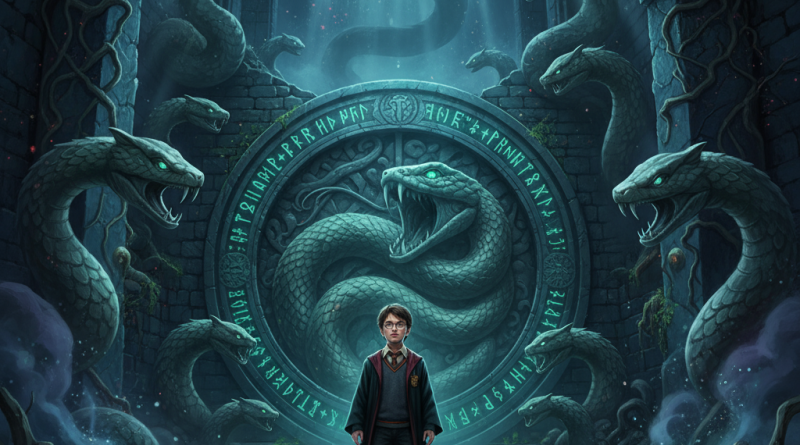
Harry Potter and the Chamber of Secrets: a complete Book Guide
The Boy Who Lived returns
Following the phenomenal success of Harry Potter and the Philosopher’s Stone, J.K. Rowling faced the daunting task of delivering a sequel that could live up to the magic of the first. With Harry Potter and the Chamber of Secrets, she not only met those expectations but exceeded them, plunging readers into a darker, more complex, and deeply personal chapter of Harry’s journey.
Published on July 2, 1998, in the UK, the second installment of the series proved that the Wizarding World was far from a one-hit wonder. It cemented Harry Potter’s place in literary history and set the stage for the epic saga that would follow [1].
This article delves into the shadows of the Chamber of Secrets, exploring its intricate plot, the introduction of crucial characters and concepts, its profound themes, and its enduring cultural impact. From the chilling whispers in the walls of Hogwarts to the climactic battle with a legendary beast, we will uncover the secrets that make this book a pivotal and unforgettable part of the Harry Potter series.
Publication details
J.K. Rowling has openly admitted that she found writing Chamber of Secrets to be a challenge, driven by the fear that it would not live up to the hype of its predecessor [2]. The pressure was immense. The first book had become a global sensation, and readers were eagerly awaiting the next chapter in Harry’s story. Rowling later revealed that she experienced significant self-doubt during the writing process, questioning whether she could recapture the magic that had made the first book so beloved.
After submitting the initial manuscript to Bloomsbury, she took the unprecedented step of taking it back for a six-week revision. This decision was not taken lightly, but Rowling felt that the story needed more work to meet her own exacting standards. She refined plot points, deepened character development, and ensured that every element of the story served a purpose. The effort paid off. Upon its release, the book was met with widespread acclaim from critics and young readers alike, solidifying the series’ commercial and critical success.
|
Publication Detail
|
Information
|
|
UK Release Date
|
2 July 1998
|
|
US Release Date
|
2 June 1999
|
|
UK Publisher
|
Bloomsbury
|
|
US Publisher
|
Scholastic Inc.
|
|
UK First Edition Pages
|
251
|
|
US First Edition Pages
|
341
|
|
Original UK ISBN
|
0-7475-3849-2
|
|
Preceded by
|
Harry Potter and the Philosopher’s Stone
|
|
Followed by
|
Harry Potter and the Prisoner of Azkaban
|
The book’s success was not limited to the English-speaking world. It was quickly translated into dozens of languages, reaching readers across the globe. The book won numerous awards, including the prestigious British Book Award for Children’s Book of the Year, and spent months at the top of bestseller lists worldwide [3].
Dedication: a tribute to a foul-weather friend
“For Séan P.F. Harris, getaway driver and foul-weather friend.”
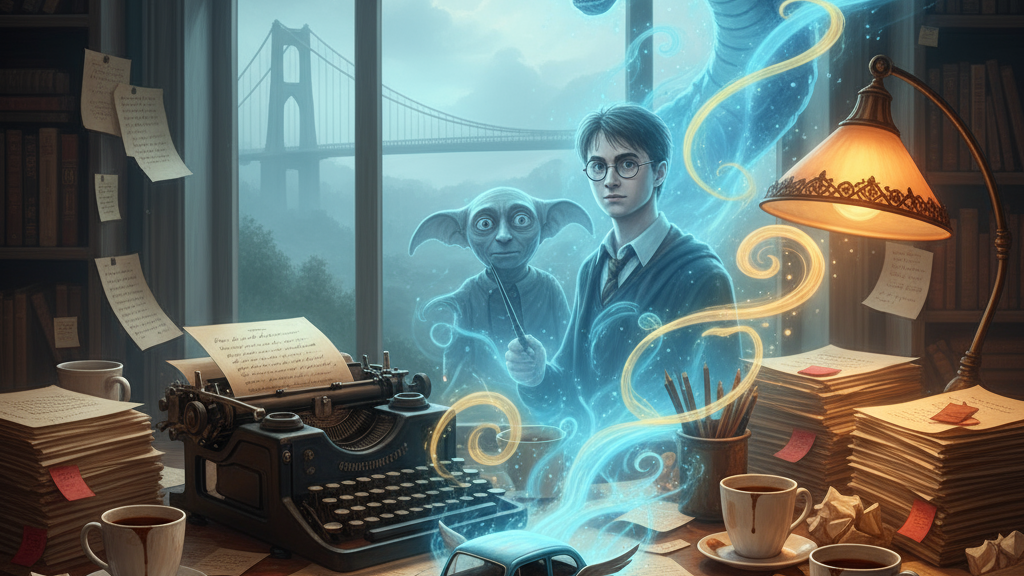
The dedication of Chamber of Secrets is a heartfelt tribute to one of Rowling’s oldest friends, Sean Harris. He was a friend from her school days at Wydean Comprehensive in Gloucestershire, England. During a difficult period in Rowling’s youth, when she felt isolated and trapped in the small town of Tutshill, Sean became her lifeline to the outside world. In 1982, he would arrive outside her family home in his blue Ford Anglia and whisk her away to the concerts and bars of Bristol, offering her an escape from the “grim stillness” of her surroundings [4].
The two friends would park under the Severn Bridge and dream up better futures for each other. Sean’s blue Ford Anglia would become immortalized in Rowling’s fiction as the Weasleys’ enchanted flying car, a symbol of freedom and adventure. The dedication beautifully captures the essence of their friendship—a reliable presence through thick and thin, much like Ron Weasley is for Harry. The phrase “foul-weather friend” is a play on the more common “fair-weather friend,” emphasizing that Sean was there for Rowling during the difficult times, not just the good ones.
The story behind the story: a darker tale
Creating Chamber of Secrets was a formative experience for Rowling as a writer. She has spoken candidly about the challenges she faced, particularly the fear of the “difficult second album” syndrome. The first book had been a labor of love, written over several years with no guarantee of publication. The second, however, came with expectations and deadlines. Rowling found herself grappling with the pressure to deliver a story that was both familiar and fresh, that honored the world she had created while pushing the narrative forward into darker, more complex territory.
One of the most significant creative decisions Rowling made was to introduce the concept of the Horcrux, though the term itself would not be revealed until Half-Blood Prince. Tom Riddle’s diary is the first Horcrux Harry encounters, and its destruction sets a crucial precedent for the series’ ultimate resolution. Rowling has stated that she had the entire seven-book arc planned from the beginning, and Chamber of Secrets was designed to plant seeds that would bear fruit in later installments [5].
During the revision process, Rowling made several cuts to the manuscript. One notable deletion was a song composed by Nearly Headless Nick, explaining the circumstances of his death. While charming, Rowling’s editor felt it slowed the pace of the narrative, and it was removed. The song was later published on Rowling’s official website as a bonus for fans [6]. Similarly, a subplot involving Dean Thomas’s family background was cut, as Rowling felt it was an “unnecessary digression” that detracted from the central mystery.
Plot summary Harry Potter and Chamber of Secrets: the chamber is opened
Chapter 1-3: The worst birthday and escape to the burrow
Chamber of Secrets picks up with Harry enduring a miserable summer with the Dursleys at Number Four, Privet Drive. His twelfth birthday on July 31st is marked by loneliness and the absence of letters from his friends Ron and Hermione. The Dursleys have locked away all of Harry’s magical belongings, including his wand, broomstick, and spellbooks, and have forbidden him from even saying the word “magic.” They have also caged his beloved owl, Hedwig, to prevent her from attracting attention from the neighbors.
The Dursleys are preparing for an important dinner party with Mr. and Mrs. Mason, potential clients of Uncle Vernon’s. Harry is ordered to stay in his room, make no noise, and “pretend he doesn’t exist.” While in the garden, Harry sees a pair of enormous green eyes staring at him from the hedge. Later, he discovers that the eyes belong to Dobby, a house-elf who has come to warn him that he must not return to Hogwarts, as terrible things are going to happen there.
Dobby’s attempts to “save” Harry are well-intentioned but disastrous. When Harry refuses to promise to stay away from Hogwarts, Dobby uses a Hover Charm to smash a pudding that Aunt Petunia had made for the dinner party. The Ministry of Magic sends Harry a warning letter, accusing him of performing underage magic. Uncle Vernon, realizing that Harry cannot use magic outside of school without being expelled, locks him in his room with bars on the window.
Rescue comes in the form of Ron, Fred, and George Weasley in their father’s enchanted Ford Anglia. They break the bars off Harry’s window and help him retrieve his belongings. The Dursleys discover the escape attempt, but by the time they can intervene, Harry and his rescuers have flown away. Harry is taken to The Burrow, the chaotic and loving home of the Weasley family in Devon. Here, Harry experiences the warmth of a true magical family for the first time. Mrs. Weasley scolds her sons for taking the car without permission but quickly forgives them and makes everyone breakfast.
Chapter 4-6: Diagon Alley and the journey to Hogwarts
Harry stays at The Burrow until it is time to return to Hogwarts. The Weasleys make it clear that they all like Harry. Mr. Weasley, who works in the Misuse of Muggle Artefacts Office at the Ministry of Magic, is fascinated by Harry and insists that he sit next to him during meals. Mrs. Weasley constantly deplores the state of Harry’s hand-me-down clothes and insists that he eat extra food.
When it is time to buy school supplies, the Weasleys and Harry travel to Diagon Alley using Floo Powder. Harry has difficulty with the smoke and says “Diagon Alley” unclearly, accidentally landing in Borgin and Burkes, a shop in the ill-reputed Knockturn Alley that specializes in objects related to Dark magic. There, he witnesses Lucius Malfoy, father of Draco Malfoy, selling dark artifacts to Mr. Borgin. Lucius explains that the Ministry has been conducting raids on wizard houses to uncover illegal items, so he is selling his more problematic possessions. He also expresses his disdain for a rumored Muggle Protection Act, which he (rightly) assumes Arthur Weasley is behind.
Hagrid rescues Harry from Knockturn Alley and takes him to Diagon Alley, where he reunites with the Weasleys and Hermione. They visit Flourish and Blotts, where the famous author Gilderoy Lockhart is signing copies of his autobiography, Magical Me. Lockhart, a vain and flamboyant wizard, announces that he will be the new Defense Against the Dark Arts teacher at Hogwarts. He spots Harry in the crowd and uses the opportunity for a photo op, much to Harry’s embarrassment. At Flourish and Blotts, Lucius Malfoy and Arthur Weasley get into a heated argument about blood purity and the treatment of Muggles, which escalates into a physical altercation.
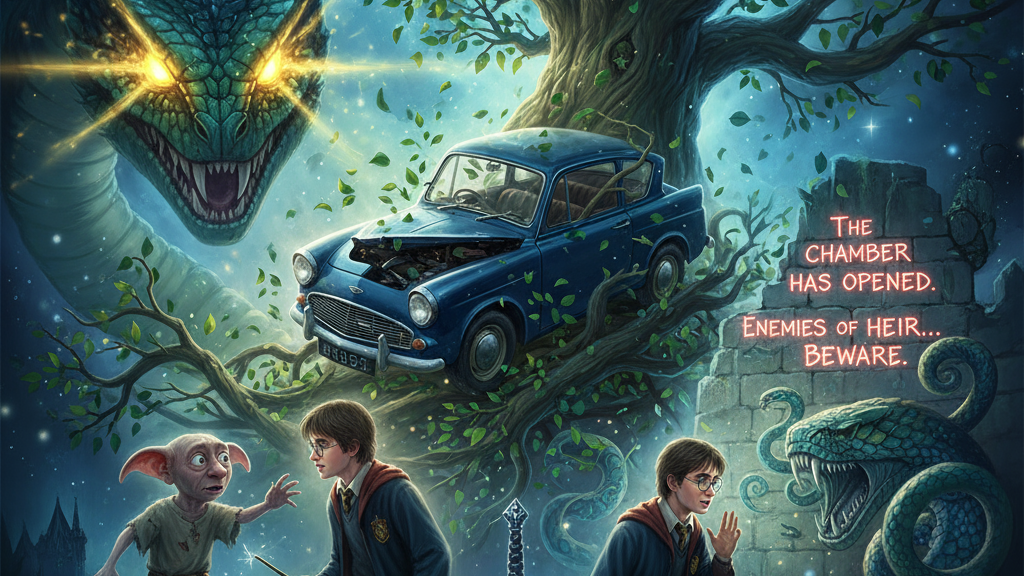
On September 1st, Harry and the Weasleys head to King’s Cross Station to board the Hogwarts Express. However, when Harry and Ron try to pass through the magical barrier to Platform 9¾, they find it sealed. Panicking, they decide to fly to Hogwarts in the enchanted Ford Anglia. The journey is initially exhilarating, but the car’s invisibility booster malfunctions, and they are spotted by several Muggles. They arrive at Hogwarts just as the car runs out of power and crash into the Whomping Willow, a violent tree on the school grounds. Ron’s wand is broken in the crash, and the car ejects them before driving off into the Forbidden Forest.
Chapter 7-10: The Chamber is opened
The school year begins with a series of ominous events. Gilderoy Lockhart proves to be an incompetent teacher, more interested in self-promotion than actual instruction. During a Quidditch practice, a rogue Bludger targets Harry, breaking his arm. Lockhart attempts to mend it but accidentally removes all the bones instead, sending Harry to the hospital wing. That night, Dobby visits Harry and reveals that he was responsible for sealing the barrier at King’s Cross and for jinxing the Bludger, all in an attempt to force Harry to leave Hogwarts.
Soon after, a chilling message appears on a castle wall, written in what appears to be blood: “THE CHAMBER OF SECRETS HAS BEEN OPENED. ENEMIES OF THE HEIR, BEWARE.” Mrs. Norris, the caretaker Argus Filch’s beloved cat, is found hanging by her tail, petrified. The legend of the Chamber—a hidden room created by Salazar Slytherin containing a monster that only the Heir of Slytherin can control—spreads through the school. According to the legend, the monster will purge the school of all Muggle-born students.
Harry, Ron, and Hermione begin investigating the mystery. They learn that the Chamber was opened fifty years prior, leading to the death of a student and the expulsion of Rubeus Hagrid, who was accused of opening it. During a dueling club session led by Lockhart and Professor Snape, Harry is matched against Draco Malfoy. Malfoy conjures a snake, and Harry instinctively speaks to it in Parseltongue, the language of snakes. The entire school witnesses this, and many students begin to suspect that Harry is the Heir of Slytherin, as Parseltongue is a rare ability associated with dark wizards.
Chapter 11-14: The Polyjuice potion and the diary
Hermione devises a plan to brew Polyjuice Potion, a complex potion that allows the drinker to assume the appearance of another person. Harry and Ron use it to transform into Vincent Crabbe and Gregory Goyle, Draco’s cronies, to interrogate him about the Chamber. However, they discover that Draco knows nothing about who opened it, though he gleefully reveals that the Chamber was opened before and that a Muggle-born student died.
More students are petrified, including Colin Creevey, a first-year who idolizes Harry, and Justin Finch-Fletchley, a Hufflepuff student. The school is thrown into a state of panic. Harry finds a mysterious diary in Moaning Myrtle’s bathroom. The diary is blank, but when Harry writes in it, a boy named Tom Riddle writes back. Through the diary, Harry is transported into a memory from fifty years ago, where he witnesses Riddle accusing Hagrid of opening the Chamber and keeping a dangerous creature (Aragog, a giant spider) in a cupboard. Hagrid is expelled, and Riddle receives an award for special services to the school.
Harry is convinced that Hagrid is innocent, but the evidence seems damning. When Hermione is petrified after discovering a crucial clue, Harry and Ron are more determined than ever to solve the mystery. They follow spiders into the Forbidden Forest, where they meet Aragog, the ancient spider that Hagrid raised. Aragog reveals that he is not the monster from the Chamber and that the creature that killed the girl fifty years ago is something spiders fear above all else.
Chapter 15-18: The heir of slytherin
When Ginny Weasley is taken into the Chamber, Harry and Ron find the entrance in Moaning Myrtle’s bathroom. Myrtle reveals that she was the student who died fifty years ago, killed by a pair of large yellow eyes. Harry realizes that the monster is a Basilisk, a giant serpent that can kill with a direct gaze and petrify with an indirect gaze (through reflections, ghosts, or cameras). The Basilisk has been traveling through the school’s plumbing system, which is why Harry has been hearing its voice in the walls.
Harry, Ron, and Lockhart enter the Chamber through a tunnel beneath the sink. Lockhart attempts to erase the boys’ memories with Ron’s broken wand, but the spell backfires, causing a cave-in that separates Harry from Ron and obliterates Lockhart’s memory. Harry continues alone and finds Ginny lying unconscious in the Chamber. A manifestation of Tom Riddle appears, revealing that he is the Heir of Slytherin and a younger version of Lord Voldemort. Riddle explains that he preserved his sixteen-year-old self in the diary and has been possessing Ginny, using her to open the Chamber and set the Basilisk on Muggle-borns.
Riddle summons the Basilisk to kill Harry. In a desperate battle, Harry is aided by Fawkes, Dumbledore’s phoenix, who blinds the Basilisk and brings Harry the Sorting Hat. From the Hat, Harry pulls the Sword of Gryffindor, a weapon that appears to those who show true bravery. Harry slays the Basilisk but is poisoned by one of its fangs. Fawkes’s healing tears save him, and Harry uses the Basilisk fang to stab Tom Riddle’s diary, destroying the fragment of Voldemort’s soul within it. Ginny awakens, and they return to the school, where all the petrified students are cured with Mandrake Restorative Draught.
In a final act of cleverness, Harry tricks Lucius Malfoy (who had planted the diary on Ginny) into freeing Dobby by hiding the destroyed diary inside one of his own socks and giving it to Malfoy. When Malfoy throws the sock away in disgust, Dobby catches it, and by the rules of house-elf servitude, he is freed.
Main characters
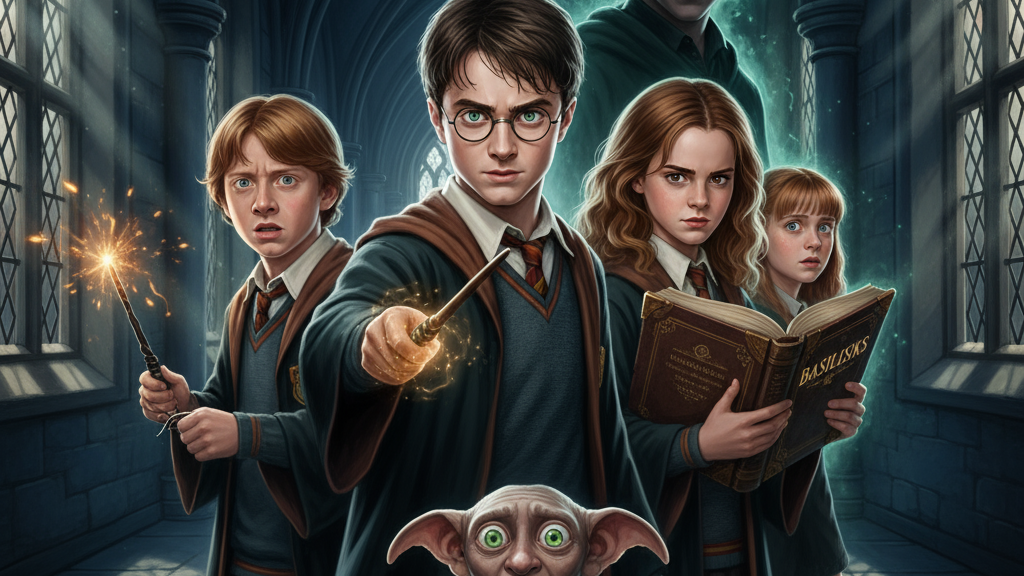
Harry Potter
Harry’s journey in Chamber of Secrets is one of profound self-doubt and identity crisis. The discovery of his Parseltongue ability forces him to question whether he is truly different from Voldemort. The entire school suspects him of being the Heir of Slytherin, and even his friends have moments of uncertainty. Harry begins to wonder if the Sorting Hat made a mistake by placing him in Gryffindor, fearing that he might have been better suited for Slytherin.
This internal struggle is central to Harry’s character development. He is terrified that he might be destined for darkness, that some part of him is inherently evil. It is only through his choices—his decision to fight for what is right, to protect his friends, and to stand against Voldemort—that he proves his worth. Dumbledore’s words to Harry at the end of the book are among the most important in the entire series: “It is our choices, Harry, that show what we truly are, far more than our abilities.” This message becomes a guiding principle for Harry throughout the series.
Ron Weasley
Ron’s loyalty shines brighter than ever in Chamber of Secrets. He faces his greatest fear—spiders—to help Harry, venturing into the Forbidden Forest to confront Aragog despite his terror. When the entire school turns against Harry, Ron never wavers in his support. He is willing to risk expulsion, injury, and even death to stand by his best friend.
Ron’s character also provides much of the book’s humor. His broken wand causes chaos throughout the year, from backfiring spells to belching slugs. Despite his insecurities about his family’s financial situation and his position as the youngest Weasley boy, Ron proves time and again that he is brave, resourceful, and fiercely loyal.
Hermione Granger
Hermione’s intellect is crucial to solving the mystery of the Chamber. She is the one who devises the plan to brew Polyjuice Potion, a feat that requires advanced magical knowledge and meticulous preparation. Even after being petrified, her research provides the final clue that helps Harry and Ron identify the monster. In her petrified hand, she clutches a page torn from a library book about Basilisks, with the word “pipes” written in her handwriting.
Hermione also faces the harsh reality of prejudice in the Wizarding World. She is called a “Mudblood” by Draco Malfoy, a deeply offensive slur for Muggle-born wizards. This experience is deeply hurtful, but it also strengthens her resolve to fight against such bigotry. Hermione’s character represents the triumph of merit and hard work over inherited privilege.
Ginny Weasley
Though Ginny is a background character for much of the book, her role is central to the plot. As a shy and impressionable first-year, she is the perfect target for Tom Riddle’s manipulation. She pours her heart out to the diary, confiding her fears, her crush on Harry, and her feelings of inadequacy as the only girl in a family of boys. Riddle uses this vulnerability to possess her, forcing her to open the Chamber and set the Basilisk on students.
Ginny’s experience highlights the seductive and dangerous nature of dark magic. She is not evil; she is a victim. Her story is a cautionary tale about the dangers of trusting unknown entities and the ease with which innocence can be exploited. By the end of the book, Ginny is traumatized but alive, and her experience will shape her character in later books.
New characters introduced
Dobby: the self-punishing house-elf
Dobby is one of the most memorable characters introduced in Chamber of Secrets. A house-elf bound to serve the Malfoy family, Dobby is fiercely loyal to Harry, despite having never met him before. He is willing to endure severe punishment (including ironing his own hands and banging his head against walls) to try to protect Harry from the danger at Hogwarts.
Dobby’s character introduces the concept of house-elf enslavement, a form of institutionalized oppression that will become a significant theme in later books. House-elves are magically bound to serve their masters and can only be freed if their master gives them clothing. Dobby’s liberation at the end of the book is a triumphant moment, and he becomes a key ally to Harry in subsequent installments.
Gilderoy Lockhart: the charismatic fraud
Gilderoy Lockhart is a satirical critique of celebrity culture and incompetence in positions of authority. He is a handsome, charming wizard who has written numerous bestselling books about his supposed heroic adventures. In reality, Lockhart is a fraud who has used Memory Charms to steal the accomplishments of other wizards and claim them as his own.
Lockhart’s character is both comedic and cautionary. He is vain, self-absorbed, and utterly useless in a crisis. His incompetence is played for laughs throughout the book, but his ultimate fate—losing his memory when his spell backfires—is a fitting punishment for his deceit. Rowling has stated that Lockhart was inspired by a real person she knew, someone who was “even more objectionable than his fictional counterpart” [7].
Tom Marvolo Riddle: the young voldemort
Tom Riddle is one of the most chilling characters in the series. As a preserved memory of a sixteen-year-old Voldemort, he is charming, intelligent, and deeply manipulative. He presents himself as a hero who saved the school fifty years ago, but in reality, he is the one who opened the Chamber and unleashed the Basilisk.
Riddle’s character provides crucial insight into Voldemort’s origins. He reveals that he is the last descendant of Salazar Slytherin and that he despises his Muggle father. The name “Tom Marvolo Riddle” is an anagram of “I am Lord Voldemort,” a revelation that underscores his rejection of his Muggle heritage and his embrace of his dark destiny. The diary is later revealed to be a Horcrux, a fragment of Voldemort’s soul, making it the first step in his quest for immortality.
Lucius Malfoy: the corrupt aristocrat
Lucius Malfoy is the patriarch of the Malfoy family and a former Death Eater. He is wealthy, influential, and deeply prejudiced against Muggles and Muggle-borns. Lucius embodies the corruption within the Ministry of Magic, using his wealth and connections to manipulate the system to his advantage.
It is Lucius who plants Tom Riddle’s diary on Ginny Weasley, hoping to discredit Arthur Weasley and his Muggle Protection Act. His actions set the entire plot in motion, and his manipulation of Ginny is a calculated act of cruelty. Lucius’s character represents the insidious nature of systemic prejudice and the dangers of unchecked power.
Moaning Myrtle: the tragic ghost
Moaning Myrtle is the ghost of Myrtle Warren, a Muggle-born student who was killed by the Basilisk fifty years ago. She haunts the girls’ bathroom on the second floor, where she died. Myrtle is a tragic figure, a lonely and bullied girl who was in the wrong place at the wrong time.
Myrtle’s character provides a direct link to the past and is instrumental in helping Harry solve the mystery. She shows him the diary and later reveals the location of the Chamber’s entrance. Her story is a poignant reminder of the real cost of prejudice and violence.
Themes and Analysis: deeper and darker
Chamber of Secrets delves into themes that would become central to the entire series, exploring complex issues with nuance and depth.
Prejudice and blood purity
The theme of prejudice is made explicit in Chamber of Secrets with the introduction of the slur “Mudblood,” a deeply offensive term for Muggle-born wizards. The persecution of Muggle-borns is a direct parallel to real-world racism, and the book condemns it unequivocally. The Chamber of Secrets itself is a symbol of Salazar Slytherin’s belief in blood purity, a twisted ideology that seeks to eradicate those deemed “unworthy.”
The book explores how prejudice is passed down through generations. Lucius Malfoy’s bigotry is mirrored in his son Draco, who parrots his father’s beliefs without question. The Weasleys, in contrast, represent the opposite viewpoint, embracing Muggles and Muggle-borns with open arms. Arthur Weasley’s fascination with Muggle technology and his work on the Muggle Protection Act are acts of defiance against the prevailing prejudice in the Wizarding World.
Choices vs. abilities
The book’s most powerful message is delivered by Dumbledore: “It is our choices, Harry, that show what we truly are, far more than our abilities.” This theme is the cornerstone of Harry’s character and the moral foundation of the series. Harry and Voldemort share many similarities—both are Parselmouths, both are orphans, both are powerful wizards—but their choices define them.
Harry chooses to fight for what is right, to protect the innocent, and to stand against evil. Voldemort chooses power, domination, and the pursuit of immortality at any cost. The Sorting Hat wanted to place Harry in Slytherin, but Harry asked not to be, and that choice made all the difference. This theme resonates throughout the series, reminding readers that we are not defined by our circumstances or our abilities, but by the choices we make.
Identity and self-doubt
Harry’s struggle with his identity is a profound exploration of self-doubt and fear. He is terrified that he might be like Voldemort, that some part of him is inherently dark. The discovery of his Parseltongue ability only deepens this fear. He wonders if the Sorting Hat made a mistake, if he truly belongs in Gryffindor.
This internal conflict is relatable to readers of all ages. Many people struggle with feelings of inadequacy, fear that they are not good enough, or worry that they might be fundamentally flawed. Harry’s journey teaches us that these fears are natural, but they do not define us. It is our actions, our choices, and our willingness to stand up for what is right that truly matter.
The danger of uncritical trust
Tom Riddle’s diary serves as a powerful warning against blindly trusting information from unknown sources. Ginny’s innocent correspondence with the diary has devastating consequences. She pours her heart out to it, believing it to be a sympathetic friend, but in reality, it is a tool of manipulation and control.
This theme is particularly relevant in the digital age, where misinformation and manipulation are rampant. The diary is a metaphor for the dangers of uncritical acceptance of information, especially from sources whose motives and reliability cannot be verified. Ginny’s experience is a cautionary tale about the importance of skepticism and critical thinking.
Institutional authority
Chamber of Secrets portrays institutional authority as self-serving and incompetent. Gilderoy Lockhart, the Defense Against the Dark Arts teacher, is a fraud who is more interested in self-promotion than protecting students. The Ministry of Magic is shown to be corrupt and easily manipulated by wealthy individuals like Lucius Malfoy. Even Dumbledore, the most powerful wizard in the world, is temporarily removed from his position as Headmaster by political maneuvering.
The book suggests that institutions are only as good as the people who run them, and that blind faith in authority can be dangerous. It is up to individuals—like Harry, Ron, and Hermione—to take action when institutions fail.
The Basilisk and the Chamber: mythology and symbolism
The Basilisk is one of the most fearsome creatures in the Harry Potter universe. In mythology, the Basilisk (also known as the “King of Serpents”) is a legendary reptile reputed to be the king of serpents and said to have the power to cause death with a single glance. Rowling draws on this rich mythological tradition, creating a creature that is both terrifying and symbolic.
The Basilisk in Chamber of Secrets is a giant serpent that can kill with a direct gaze and petrify with an indirect gaze. It has been living in the Chamber for a thousand years, waiting for the Heir of Slytherin to unleash it. The creature is a symbol of Salazar Slytherin’s hatred and his desire to purge the school of Muggle-borns. It is also a manifestation of the dark legacy that can be passed down through generations.
The Chamber itself is a hidden space beneath the school, accessible only through Parseltongue. It is a place of secrets and darkness, a physical representation of the prejudice and fear that lurk beneath the surface of the Wizarding World. The Chamber’s existence is a reminder that evil can hide in plain sight, waiting for the right moment to emerge.
The first Horcrux: a masterclass in foreshadowing
One of the most significant aspects of Chamber of Secrets in retrospect is its introduction of the first Horcrux. Though the term is not used until Half-Blood Prince, Tom Riddle’s diary is a fragment of Voldemort’s soul, designed to preserve his life and continue his work. The diary is a sentient object, capable of communication and manipulation, and its destruction is a crucial step in Harry’s ultimate defeat of Voldemort.
The concept of the Horcrux is one of the darkest elements of the series. To create a Horcrux, a wizard must commit murder, the most evil act imaginable, and use the resulting trauma to split their soul. The soul fragment is then hidden in an object, making the wizard nearly immortal. Voldemort creates seven Horcruxes (including the unintentional one in Harry), and their destruction becomes the central quest of the final books.
The diary’s destruction by Harry with a Basilisk fang sets a crucial precedent. Basilisk venom is one of the few substances powerful enough to destroy a Horcrux, and this knowledge becomes vital in later books. Rowling’s foreshadowing is masterful, planting seeds in Chamber of Secrets that will bear fruit five books later.
Literary style and structure: a maturing voice
Chamber of Secrets marks a maturation in Rowling’s writing style. While Philosopher’s Stone was whimsical and lighthearted, Chamber of Secrets is darker and more complex. The tone is more serious, the stakes are higher, and the themes are more mature. Rowling’s prose is more confident, and her ability to weave together multiple plot threads is more refined.
The book’s structure follows the classic mystery format. Clues are scattered throughout the narrative, and the reader is invited to solve the puzzle alongside Harry, Ron, and Hermione. The revelation of the Basilisk and Tom Riddle’s identity are satisfying payoffs to the careful setup. Rowling also employs the “Chekhov’s gun” principle effectively—every element introduced in the story serves a purpose, from the Basilisk fang to the Sword of Gryffindor.
The pacing is well-balanced, with moments of tension and action interspersed with quieter character development. The climactic battle in the Chamber is thrilling and emotionally resonant, and the resolution ties up loose ends while setting the stage for future books.
Reception and critical response
Chamber of Secrets was a massive commercial and critical success. It debuted at number one on bestseller lists in both the UK and the US and remained there for months. Critics praised Rowling’s ability to deepen the world of Harry Potter while maintaining the charm and wonder of the first book. The book won numerous awards, including the British Book Award for Children’s Book of the Year and the Nestlé Smarties Book Prize [8].
Some critics, however, expressed concern that the book might be too frightening for younger children. The themes of prejudice, the violence of the Basilisk attacks, and the psychological manipulation of Ginny were seen as darker than the first book. Rowling defended her choices, stating that children are capable of handling complex and difficult themes when presented in an age-appropriate manner [9].
The book also sparked religious debates, with some religious groups condemning its use of magical themes and witchcraft. Others, however, praised the book’s emphasis on self-sacrifice, loyalty, and the importance of moral choices. These debates would continue throughout the series, reflecting the broader cultural conversations about the role of fantasy literature in children’s lives.
Cultural impact and legacy
Chamber of Secrets solidified the Harry Potter series as a global phenomenon. The book’s success proved that the first book was not a fluke, and it paved the way for the remaining five installments. The series became a cultural touchstone, influencing a generation of readers and inspiring countless works of fan fiction, art, and analysis.
The book’s themes of prejudice and the importance of choices have resonated with readers around the world. The character of Dobby, in particular, became a fan favorite, and his quest for freedom inspired discussions about social justice and the treatment of marginalized groups. The book’s exploration of identity and self-doubt has provided comfort to countless readers struggling with their own insecurities.
The introduction of the Horcrux concept, though not named until later, is one of the most significant contributions to the series’ mythology. It provides a clear goal for the final books and adds layers of complexity to Voldemort’s character. The diary’s destruction is a moment of triumph, a reminder that even the darkest magic can be defeated.
Film adaptation: bringing the Chamber of Secrets to life
The film adaptation of Harry Potter and the Chamber of Secrets, directed by Chris Columbus and released in November 2002, was a box office success, grossing over $879 million worldwide [10]. The film remained largely faithful to the book, though some subplots were condensed or removed for pacing.
The visual effects were a highlight, particularly the depiction of the Basilisk and the Chamber itself. The creature was brought to life through a combination of CGI and animatronics, creating a terrifying and believable monster. The flying car sequence was also a fan favorite, capturing the sense of adventure and danger from the book.
The cast continued to impress, with Daniel Radcliffe, Rupert Grint, and Emma Watson growing into their roles as Harry, Ron, and Hermione. Kenneth Branagh’s portrayal of Gilderoy Lockhart was widely praised for its comedic timing and over-the-top vanity. The film received generally positive reviews, though some critics felt it was too long and too faithful to the source material, lacking the streamlined pacing of the first film.
Conclusion: a key chapter in the saga
Harry Potter and the Chamber of Secrets is more than just a sequel; it is a crucial, formative chapter in the Harry Potter saga. It deepens the lore, darkens the tone, and introduces concepts and characters that are fundamental to the overarching plot. By forcing Harry to confront his own inner darkness and the prejudice of the world around him, the book lays the groundwork for the difficult choices and epic battles that lie ahead.
The book’s exploration of identity, prejudice, and the power of choices resonates as strongly today as it did when it was first published. It is a story of bravery, loyalty, and the profound truth that our choices, not our circumstances, define who we are. Chamber of Secrets is a testament to J.K. Rowling’s skill as a storyteller and her ability to create a world that is both magical and deeply human.
As we close the cover on this chapter of Harry’s journey, we are left with a sense of anticipation for what lies ahead. The Chamber has been sealed, the Basilisk has been slain, and Dobby has been freed. But the shadows of Voldemort’s past linger, and the seeds of future conflicts have been planted. The adventure is far from over, and the best is yet to come.
References
[1] Rowling, J.K. “Writing Chamber of Secrets.” J.K. Rowling Official Website. https://www.jkrowling.com/
[2] Wikipedia. “Harry Potter and the Chamber of Secrets.” https://en.wikipedia.org/wiki/Harry_Potter_and_the_Chamber_of_Secrets
[3] British Book Awards. “Children’s Book of the Year Winners.” https://www.britishbookawards.co.uk/
[4] Harry Potter Fandom Wiki. “Sean Harris.” https://harrypotter.fandom.com/wiki/Sean_Harris
[5] Rowling, J.K. Interview with Scholastic. “Planning the Seven-Book Arc.” https://www.scholastic.com/
[6] J.K. Rowling Official Website. “Nearly Headless Nick’s Song.” https://www.jkrowling.com/
[7] Rowling, J.K. Interview. “The Inspiration for Gilderoy Lockhart.” https://www.jkrowling.com/
[8] Nestlé Smarties Book Prize. “Past Winners.” https://www.nestle.co.uk/
[9] Rowling, J.K. Interview. “Addressing Concerns About Dark Themes.” https://www.jkrowling.com/
[10] Box Office Mojo. “Harry Potter and the Chamber of Secrets (2002).” https://www.boxofficemojo.com/